
Choosing 5-inch props seems simple until you run into names like 5136-3 or 51466 and dozens of models that look the same at first glance. Props are the cheapest part of your drone, and yet they change a lot about how it flies.
In this guide to 5-inch props we explain what each number means, what trade-off sits behind pitch and blade count, and what to check before you buy.
How to read the names of 5-inch props
Most manufacturers sum up a prop in three figures: diameter, pitch and blade count. A 5136-3 has a 5.1-inch diameter, a 3.6-inch pitch and 3 blades.
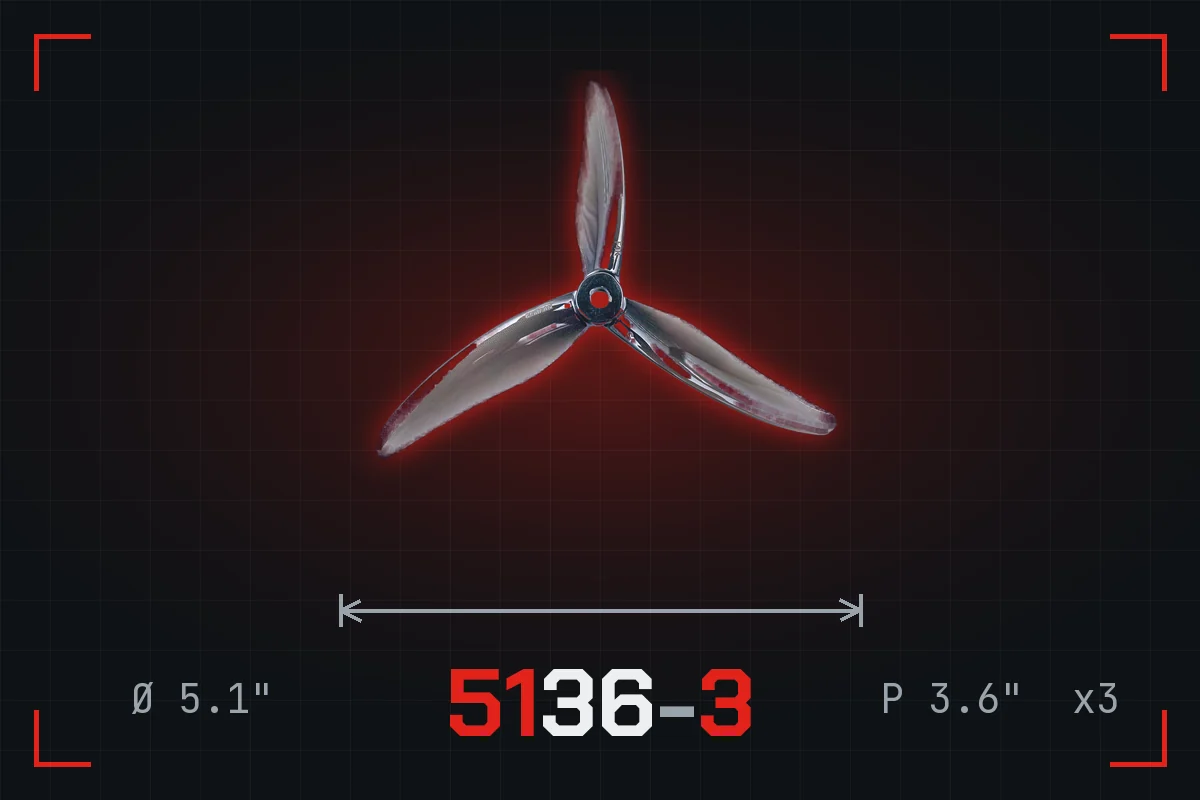
Some models use a commercial name, such as Freestyle 4S, and others follow different codes. That is why it pays to check the measurements on the product page rather than trusting the name alone.
Diameter: 5 inches is rarely exactly 5
Five inches is 127 mm, but many 5-inch props measure a little more. The Gemfan Freestyle 4S measures 129 mm and the Gemfan 51466 MCK V2 reaches 131.8 mm.
Those millimetres matter: the blade must not touch the frame arm or get too close to the neighbouring prop. If your frame is a tight fit, turn the prop by hand before tightening the nut.
Pitch: speed or control
Pitch tells you how far the prop would travel in one full turn. More pitch moves more air per turn, which usually brings a higher top speed in exchange for working the motor harder and draining the battery faster.
With less pitch, the drone usually feels smoother and easier to control at low speed. That is why freestyle leans towards moderate pitches and racing looks for higher ones.
Blade count: why three is the norm
On 5-inch props, three blades are the standard because they balance thrust, grip and power draw. Two blades tend to be more efficient but grip the air less. Four give more surface and more thrust in exchange for higher consumption.
Unless you have a specific reason to change, start with three blades.
Weight and material: what the name does not tell you
The less mass the motor has to move, the faster it can change speed, and you feel that in how the drone responds to the sticks. The Freestyle 4S weighs 3.6 g per prop, less than a 5-cent euro coin. The 51466 MCK V2 weighs 4.2 g.
As for material, polycarbonate (PC) is the most common in this class: it handles knocks well and is cheap to replace, which you will appreciate once you start crashing.
Motors: always check the recommendation
The prop and the motor work together. Gemfan recommends the Freestyle 4S for 550 to 750 g quads, with 2300 to 2500 KV motors on 4S or 1650 to 1950 KV on 6S, and the 51466 MCK V2 for 2207 to 2306 motors or larger.
If the motors come back very hot after a flight, try a lighter prop or one with less pitch before changing anything else.
Which 5-inch props to choose for the way you fly
| How you fly | What to look for | Example |
|---|---|---|
| Freestyle | Three blades, moderate pitch and low weight | Gemfan Freestyle 4S |
| Racing | A racing prop for larger motors | Gemfan 51466 MCK V2 |
If you are not sure where to start, a light tri-blade with a moderate pitch is the safest choice for a 5-inch freestyle quad.
What to check before buying 5-inch props
- That your frame takes the prop's real diameter, not just "5 inches".
- That your motor shafts match the centre hole, usually 5 mm.
- That your motors fall within the range the manufacturer recommends.
- That the pack includes two CW and two CCW, what a quad needs.
- That you carry spares: props break, and without them the flying day is over.
If these are your first 5-inch props
While you are learning, the fine differences between models matter less than having spares to hand. Pick a polycarbonate tri-blade recommended for your motors and buy several packs of the same model: that way all the 5-inch props in your backpack will match and you will not lose an afternoon of flying by breaking one.
Once you fly comfortably, that will be the time to try a different pitch or a lighter model and notice what changes.
How to fit your props step by step
- Unplug the battery before you start.
- Check the direction of rotation of each motor in your drone's configuration.
- Place each prop on its motor, with the curved side of the blade facing up if your drone flies with the props above the motors.
- Tighten the nut firmly without forcing it: overdoing it can damage the hub or the thread.
- Turn each prop by hand to check that it touches nothing.
- Check the nuts again after the first flights.
How to test whether a set of props suits you
The only reliable comparison is your own. Try the new 5-inch props at the same spot, with the same type of battery and changing only one thing at a time. Watch three points: how long the battery lasts, how hot the motors come back and how the drone feels in the turns.
If you change props and notice vibration or worse flight, first check the tightness and the condition of the blades. A big change of prop can also call for adjusting the filters and PIDs.
Is your drone not a 5-inch?
What you have read applies to any size: diameter, pitch, blades and weight read the same way. The diameter is set by your frame, though, and 5-inch props do not replace those of another size. The shop also has 6-inch and 8-inch options.
Common mistakes
- Mixing models on the same drone: all four props should match.
- Fitting a CW prop on a CCW motor: check the direction of rotation before tightening the nut.
- Flying on with a bent prop: it vibrates and can affect the video and the motors.
- Touching the props with the battery connected: always unplug it first.
Frequently asked questions
Can I fit 5.1-inch props on a 5-inch frame?
On many frames yes, but it depends on the design. Check that the blade turns freely and does not touch the arm or the neighbouring prop.
How many props do I need?
Four per drone, two of each rotation. It is worth carrying at least one spare pack.
Do the same props work on 4S and 6S?
Often yes, as long as the motors have the right KV for each voltage. Each prop's product page gives the ranges.
How often should I change my props?
There is no fixed interval. Inspect them before each flight and change them if you see cracks, broken tips or bent blades.
What is the difference between CW and CCW?
The direction of rotation. CW turns clockwise and CCW counter-clockwise. A quad uses two of each to balance the rotation.
Does the color of 5-inch props matter?
It does not change how the drone flies, but it helps you see it and find it. A bright color also makes it easier to spot a broken prop in the grass.