
BetaFPV has just launched, in beta, the P1 HD VRX (Nano), a $74.99 digital video receiver aimed at a very specific problem: you already own analog Fat Shark or SKYZONE goggles, perfectly adjusted to your face, and you don’t want to spend $500-700 on new digital goggles just to get an HD image. The Nano’s pitch is simple — plug it into the goggles you already have via HDMI and turn them into a digital receiver, without buying anything else that receives video.

It’s a different approach from DJI, Walksnail or HDZero, which sell the full ecosystem (goggles + receiver + transmitter) as a closed package. Here we break down what it actually is, what early independent tests say, and how it stacks up against the digital systems dominating the market in 2026.
What is the P1 HD VRX Nano?
It’s the «receiver» half of ArtLynk, BetaFPV’s affordable digital system based on the Artosyn AR803X chipset (the same silicon used by other brands like HGLRC’s Draco or TJRC). The other half is the P1 Air Unit, the $37.99 transmitter that goes on the drone.
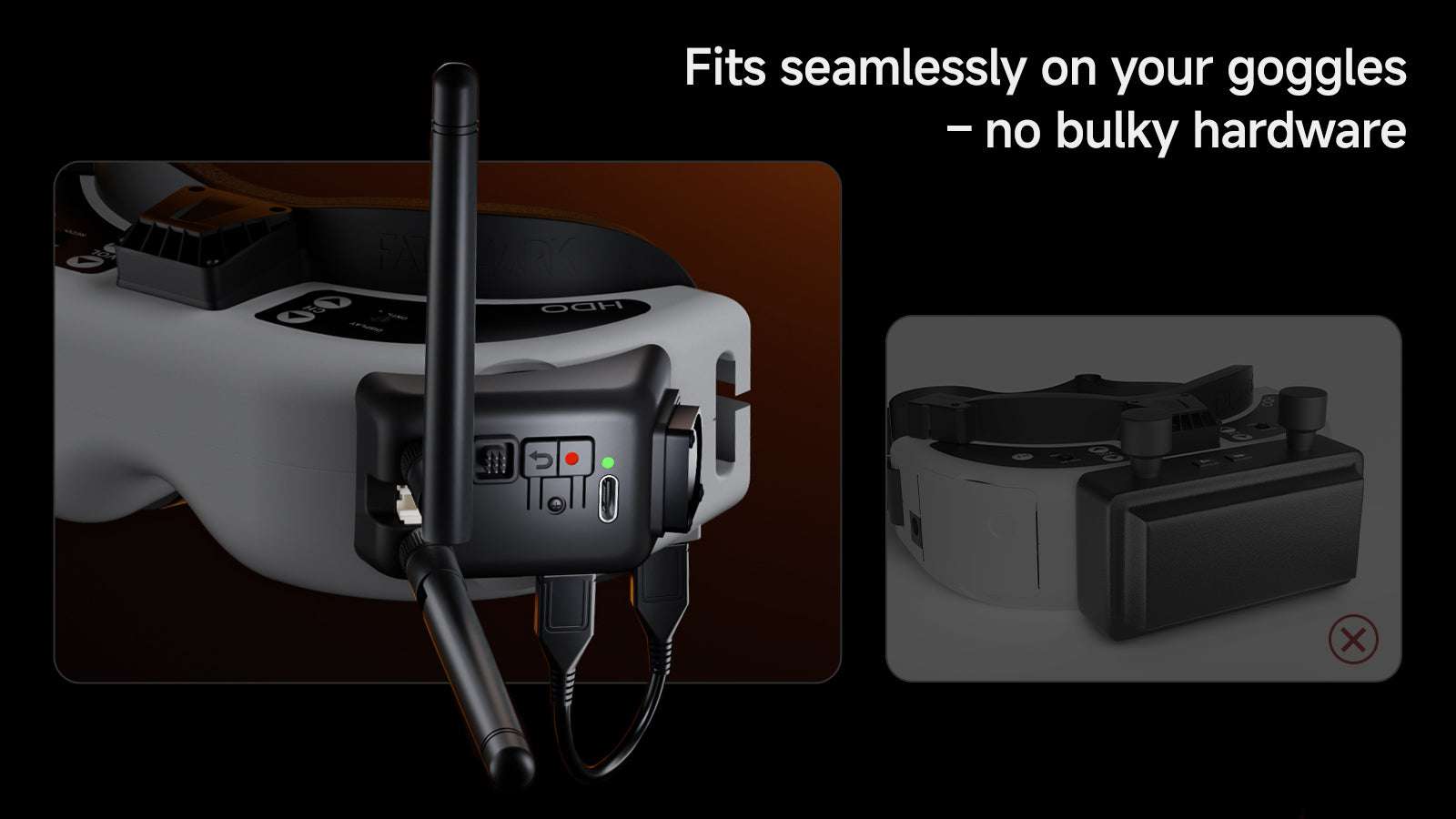
| Specification | P1 HD VRX (Nano) |
|---|---|
| Price | $74.99 (beta) |
| Compatibility | Fat Shark (HDO+, Attitude V3/V4/V6, HDO2, Dominator HD3/SE/V3) · SKYZONE (SKY04L/X/O/X PRO/O PRO) |
| Connection | Mini HDMI + USB-C + microSD (up to 1TB) |
| Resolution | 1080p@60fps, 25Mbps bitrate |
| Range | >400m claimed (tested beyond 500m in open field) |
| Weight | 33-36g depending on version (antenna excluded) |
| Frequency | 5.3–5.8GHz, multi-band |
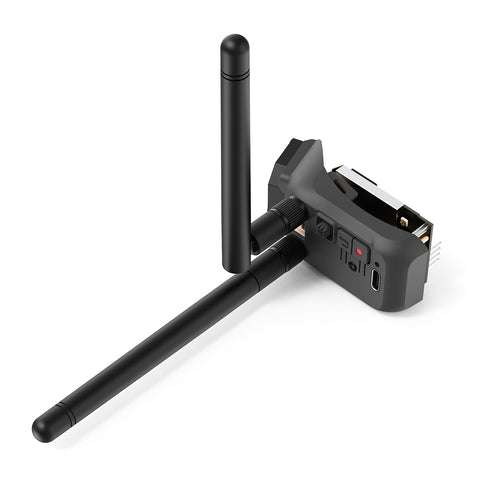
The transmitter on the drone side is the P1 Air Unit, which connects to the flight controller via the same 6-pin pinout DJI uses (though it only takes 5V — be careful there). It’s compatible with Betaflight, so if your build is already running the latest firmware, the jump to HD doesn’t require touching much else.
Latency: the number that matters most (and the weak point)
This is where it’s worth being honest, because it’s the system’s biggest catch. Oscar Liang measured the glass-to-glass latency of the ArtLynk system (the same protocol and chipset the Nano uses) with a 240fps action camera and compared it against analog and DJI O4:
Analog: 17ms · DJI O4 at 100fps: 33ms · DJI O4 at 60fps: 50ms · ArtLynk: 67ms
Almost double DJI O4’s fastest mode. For relaxed flying, exploring or long-range, it’s barely noticeable. For racing, gap diving or highly technical freestyle, it is — and several reviewers on BetaFPV’s own product page agree: «fine for whoops and chill flying, wouldn’t recommend it for racing.» If minimal latency is your priority, our Video Transmitters category has options more suited to racing.
How it compares to the big players: DJI O4, Walksnail and HDZero
| System | Approx. full system price | Glass-to-glass latency | Resolution | Ecosystem |
|---|---|---|---|---|
| BetaFPV ArtLynk (P1 Air Unit + VRX Nano) | ~$113 (using goggles you already own) | ~67ms | 1080p@60fps | Open (Artosyn), expanding: HGLRC, TJRC, XJRC |
| DJI O4 (Air Unit + Goggles 3) | ~$550-750 | 33-50ms | 1080p@100fps (O4 Pro: 4K/120fps recording) | Closed, DJI goggles only |
| Walksnail Avatar HD Pro | ~$640 | 20-22ms (race mode) | 1080p@120fps | Open, compatible with third-party goggles (including HDZero) |
| HDZero Race V3 | ~$710 | 14ms | 720p/1080p (focused on latency, not resolution) | Open, veteran racing ecosystem |
DJI O4, Walksnail and HDZero prices and latencies based on recent tests and public prices from UAVMODEL Insights, FPV Drone Guide and official stores (August 2026); may vary by region and variant.
Who is it for?
Makes sense if…
- You already own analog Fat Shark or SKYZONE goggles and don’t want to replace them
- You fly whoops, cinematic, long-range or relaxed exploration
- Your priority is the cheapest entry into HD, not maximum performance
- You don’t mind tinkering with evolving firmware/ecosystems
Better to skip if…
- You fly racing, technical freestyle or need minimal latency
- You want something that «just works» without firmware updates
- You need onboard recording (the VTX doesn’t record, only the goggles’ DVR)
- You don’t already own compatible Fat Shark/SKYZONE goggles
Our take
The P1 HD VRX Nano isn’t trying to go head-to-head with DJI O4 or Walksnail on performance. It’s answering a question many analog-goggle pilots have been asking for a while: «can I get HD without spending $600 on new goggles?» For just over $110 total (transmitter + receiver), the answer is now yes, with caveats — noticeable latency, still in beta, and a compatible-goggles ecosystem currently limited to Fat Shark and SKYZONE.
For relaxed flying, long-range, or simply trying digital image without committing to a full system, it’s one of the cheapest entries into HD we’ve seen. For racing, it’s still DJI, Walksnail or HDZero’s territory — and our HD FPV Equipment category has options for every budget.
FAQ
Does the P1 HD VRX Nano work with any analog FPV goggles?
No. It’s only compatible with specific Fat Shark models (HDO+, Attitude V3/V4/V6, HDO2, Dominator HD3/SE/V3) and SKYZONE (SKY04L/X/O/X PRO/O PRO), since each brand has a different housing version.
Do I also need to buy the P1 Air Unit?
Yes. The VRX Nano is only the receiver (goes on your goggles); to get a digital image you also need the P1 Air Unit ($37.99) installed on the drone as the transmitter.
How much does it cost to switch to HD with this system?
Adding the P1 Air Unit ($37.99) and the P1 HD VRX Nano ($74.99), the total is around $113 — well below the $550-750 a full DJI O4 system with new goggles costs.
Is it better than DJI O4?
Not in image quality or latency: the DJI O4 measures 33-50ms of glass-to-glass latency versus ~67ms for the ArtLynk system. The P1 HD VRX Nano’s advantage is price and reusing goggles you already own, not performance.